
Please ensure Javascript is enabled for purposes of website accessibility

The R&D Tax Credit: What System Integrators Need to Know

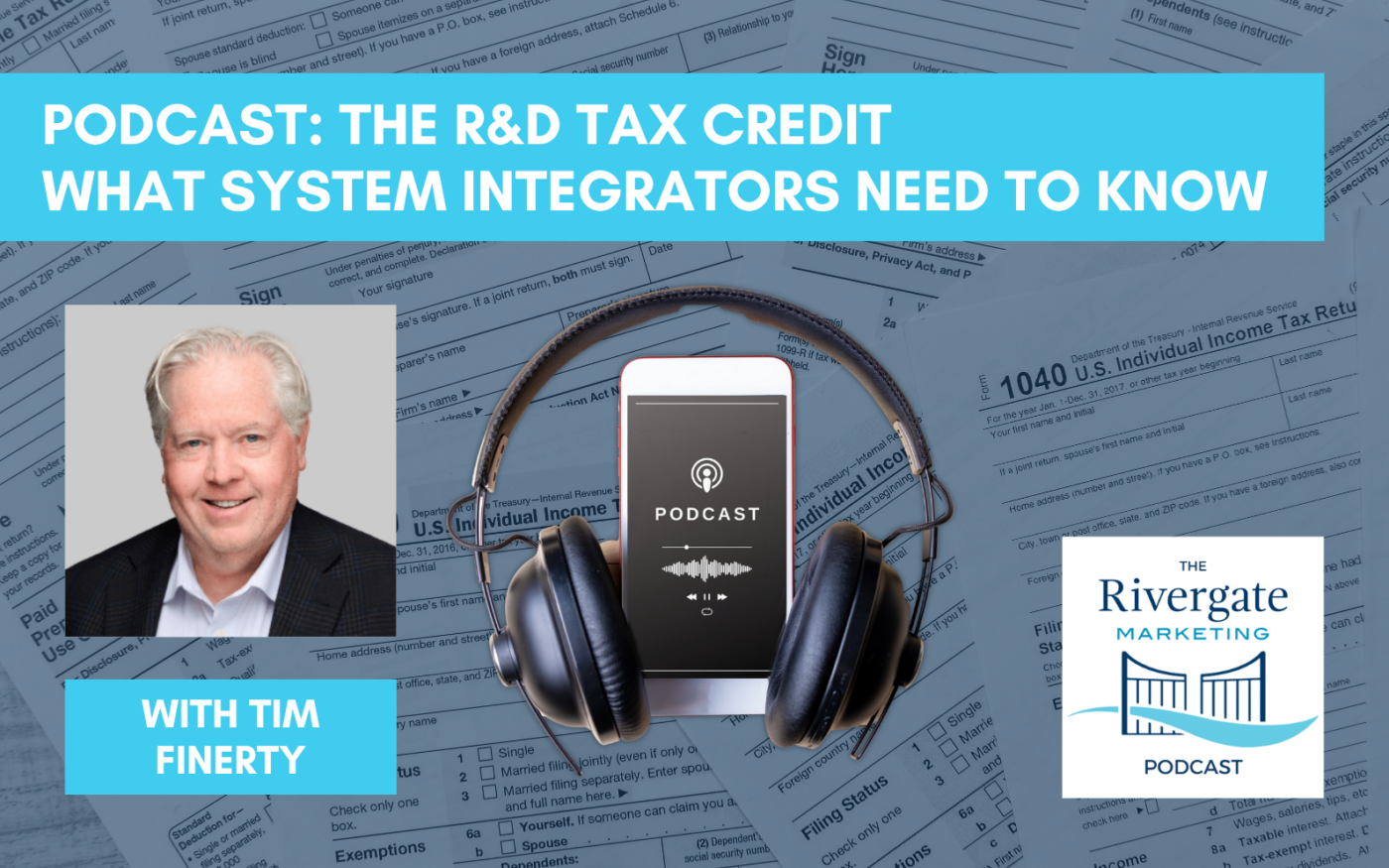
Rivergate Marketing Podcast Tim Finerty

In this episode, Tim Finerty of Wipfli, a top 20 national accounting and business consulting firm, discusses the benefits of the R&D tax credit for system integrators. Wipfli, with roots dating back 90 years, has been assisting system integrators for over a decade, focusing on M&A support, data analytics, and tax minimization strategies. Tim shares details on the recent OBBBA, which allows system integrators to expense R&D costs immediately rather than capitalizing them.

The transcript below is available for those who prefer to read along. Please be aware that it may contain minor errors. 

Christine McQuilkin | Rivergate Marketing:

Welcome to the Rivergate Marketing Podcast. Could you start by introducing yourself and Wipfli and share how you’re currently helping system integrators?

Tim Finerty | Wipfli:

Thanks Christine for having us. I’ll touch base briefly on Wipfli. Wipfli is a top 20 national accounting and business consulting firm. Roots dated back 90 years, started in Milwaukee. Recently, about two years ago, we joined Wipfli where we used to be called Clayton & McKervey. Another strategic expansion was Harbour Results, which also is in the Detroit area that helps as part of Wipfli now and helps system integrators with benchmarking and other things. I’ve been a partner at Clayton & McKervey now Wipfli for 20 plus years. I started my career at Deloitte, moved over to a smaller accounting firm, kind of focused on that middle market, grew up doing a lot of manufacturing and distribution type companies. And about 10, 15 years ago, got into understanding the system integrators. Completely different market. Tried engineering and kind of manufacturing combined together and really liked it. I went on a trade mission to Mexico and met Bob Doyle, who was part of A3. And then he introduced me to CSIA, which is another, Control System Integrators Association. Just kind of been focused on helping integrators learn more about their business and different tax and strategy ideas that are out there that we could help them with.

Christine McQuilkin | Rivergate Marketing:

That’s awesome. It sounds like you’re uniquely positioned to help our listeners hear system integrators. So the R&D tax credit has just come up from this One Big, Beautiful Bill. It’s been discussed broadly, but what does it mean specifically for system integrators? Can you help?

Tim Finerty | Wipfli:

The biggest benefit that happened in the OBB bill was that we now no longer have to capitalize the R&D cost again. So about three years ago in 2022, system integrators that were taking the R&D credits basically had to capitalize those expenditures and then depreciate or amortize those over a five, six-year period. So what was happening is these companies were getting a credit of, let’s just say $100,000 and they would have expenditures of potentially $2-3 million. And these expenditures then had to be capitalized and amortized, but all of a sudden you got $2 million of income that you have to pay tax on. And that tax on $2 million effectively is at a 30 or 40% rate and you’re talking about $600,000 of tax and only creating $100,000 of credits. So it becomes like, “oh, what is going on here?” And so this bill now has allowed us to expense it again.

And there’s a couple different ways that that can happen through this bill. That is one thing that we kind of have to take a look at to make sure that we’re doing it correctly. So if system integrators, again, are going to be focused on, I believe, the R&D credit as we move forward.

Christine McQuilkin | Rivergate Marketing:

So integrators, they might not see themselves as doing R&D. What kind of activities in system integration might qualify for this tax credit?

Tim Finerty | Wipfli:

Yeah, the way I always look at it for system integrators is engineers always seem to think that what they’re doing isn’t new. They’re able to always solve a problem. Well, for the R&D credit, really what we’ve seen with system integrators is that usually each project that they’re doing potentially is unique because something is different with them. And so because of the uniqueness of it, they usually qualify. So there’s really a four-part test that has to happen for them to qualify. The first one is basically that activity must relate to a new or improved product process or design that is intended to improve the function, performance, reliability, or quality of that. So again, if you’re doing something that’s improving that process, that’s not like re-engineering something but improving it, then it most likely is going to be qualified. Now, it also has to be technical in nature, which for system integrators, that’s mostly happening.

For example, an accounting firm might improve a process, but it’s not technical in nature. So we don’t really qualify for the R&D credit. So it’s got to have something to do with physical science, computer science, engineering, or biological sciences. And then effectively, the third one is elimination of uncertainty. The activity must be intended to discover information to eliminate that uncertainty related to the capability to improve product process or design, method to improve product, process or design or appropriateness of design. And so that’s where some of it is out there. I mean, again, we see that a lot of system integrators qualify. Now there’s certain contracts or other things that may not because of the IP rights or the rights or the customer’s rights, but usually it makes a lot of sense to really look at that. And really the fourth one is that process of experimentation.

What are we doing to eliminate that uncertainty regarding the development of the product or process, utilizing process to evaluate what alternatives are we doing to eliminate that uncertainty? And then testing, implementation, trial and error, those types of things that you’re doing to do that. And a lot of times what will happen is the engineers will think, “Well, I did that on the first project. How can I qualify on a next project?” Well, that project’s for a different customer and may have other uncertainties. If I’m building the same unit multiple times, then yes, that first one is the only one that qualifies and the remaining ones don’t.

Christine McQuilkin | Rivergate Marketing:

Is there a big documentation requirement?

Tim Finerty | Wipfli:

There is. I mean, if you ever got audited, you’d want to have a study that was done and having a third party doing that study usually is much more helpful with the IRS. Now, to take the credit off the start, theoretically you do not have to have anything. You have to fill out some forms and go through some different things, but if it were ever to get challenged, yes, you need to have that documentation. And usually what happens is you do a study and you pick some of the projects and you would document those projects, the highest value projects, and you kind of go through all those different four-part tests and document it. You put into those projects, what type of simulations did I do on making, sure, I got through it. I document the hours that I had into these jobs. And so there’s three pieces that qualify for the R&D credit, the wages, supply costs, and then contract labor, which is basically wages except that you’re using someone else.

And for system integrators, we sometimes find that the supply costs can be significant. And so that’s where there could be large credits that can be taken based off of the uncertainty of a project that you’re using robots, you’re using some fixtures that may be pretty expensive to design something and conveyor systems that are putting into place if those conveyors aren’t working right, levels and different things moving around. We’ve had ones that you’re putting certain things into plants that might be in the south that have a lot of humidity. And therefore, if you’re not understanding the controls of how to make sure that certain things get designed correctly, things can stick if you’re producing something. And so you want to make sure those are all taken into effect. And that’s where some of the uncertainty and different things come into place because you got so many variables of when you’re designing something just depending on location.

Christine McQuilkin | Rivergate Marketing:

Sounds like you have a lot of experience and would be a great resource for integrators on this.

Tim Finerty | Wipfli:

Wipfli has been doing R&D credits for 20 plus years. We’ve been working with system integrators for the last probably 10 to 12 years. It’s having the people on the team that understand this industry because it’s definitely different than someone developing computer software. I mean, that’s pretty easy and simple to understand. It’s brand new, you know that it’s different. In this industry, it’s, “okay, what does the customer ask us? How do we take it?” And really trying to find what makes the most sense and trying to do it in a reasonable way that you’re not going to have a issue if the IRS comes back and looks at it.

Christine McQuilkin | Rivergate Marketing:

So the credit just simply goes against the income or is there some special way the deduction is taken?

Tim Finerty | Wipfli:

There’s a couple different ways that you can do it, but most people, when you hear about a credit, a credit is a permanent tax difference. So you basically have on your, instead of when we were talking about before you had to capitalize the R&D cost and then you would depreciate it over time, that’s just a temporary difference. So you’re capitalizing after a certain amount of years, whatever you capitalize, you depreciate it, so you’re not paying any tax at all on it. But on a credit, you’re getting 100% of that amount as a permanent difference against your taxable income. So for example, and you can’t fully offset your taxable income against the credit, you can take your income basically down to almost like, let’s say, a 5-7% tax rate. So if I’m paying 30% on a million dollars and I had $300,000 and I had 100,000 of credits, I’d be able to reduce my tax to $200,000 right off the top. And therefore I only have to now pay the IRS and my tax rate effectively is 20% instead of 30%.

Christine McQuilkin | Rivergate Marketing:

Sure. Great. So for integrators who haven’t pursued this credit before, are there first steps you recommend to take to see if they qualify? Obviously they should reach out to you and have a discussion.

Tim Finerty | Wipfli:

Probably the easiest on their own, they can do some research on, again, that four-part test and then digging into some of that stuff. But one of the things that we do at Wipfli is we do a feasibility study that basically is a no-cost type thing. We’ll have a discussion with you, talk through some of the things, and then we’ll ask for some information and we’ll do a feasibility study that then would say, “Oh yeah, we believe that you would have $100,000 worth of credits.” And if we did that, then we would put a budget together of what we would charge the company. And the amount that we would charge or anyone would charge is based off of how much work you have to do on it, how much documentation is needed, how much of that is going to take the time. If you have some simple projects and different things like that, there’s probably some things that, okay, you put together the wages, you put together where you’re at, we can look at it and say, “Okay, well, this credit’s only going to be about $25,000. Let’s look at it, talk through some things, document a few things, and then we’re done with that.” You look at the risk, reward on some of that stuff of how much time and effort you want to put into it. If you got a million dollar credit, you want to probably put a little bit more time and effort into it and it’s going to cost some money, but it’s definitely well worth the time and effort.

Christine McQuilkin | Rivergate Marketing:

Yeah, sounds like it, especially these projects are often many zeros.

Tim Finerty | Wipfli:

One of the things too is with these credits, some states now think there’s almost 25 states that have credits as well. So the credits can be offset against your state income tax as well. Some states, one in particular that I do some work in, Arizona’s credit is as good as the federal credit, but Arizona’s tax rate is not as high. So you might have some large carryovers on some of the stuff, but the benefit for some of that could be is in the future, if the system integrator sells, you’re not going to pay any state income tax on a sale. So again, the benefit could have a long-term effect of cashflow later on in the owner’s pockets.

Christine McQuilkin | Rivergate Marketing:

That’s very interesting. I hadn’t thought about it in those terms. So this OBBB, when did it become effective? Is that going to be for the 2025 tax year?

Tim Finerty | Wipfli:

When this thing came out, we had a few clients still that hadn’t filed their 9/15 tax returns. And so during that time, we kind of did a quick analysis of, okay, should we take advantage of it in 24? And most of them did where we didn’t capitalize. We kind of made an election to take the expense in the current year and then effectively go back and take ’22 and ’23 expenses and looking at that because that made the most sense because they’re going to get some cash back right now. And because this past year for system integrators, some have had a little bit harder time because the uncertainty of all the tariffs and things like that. So projects haven’t been as heavy and different things like that. So it was an opportunity to get some cash back for some of the business owners that really were excited about it.

But in reality, the bill goes into effect. And what is now happening is really looking at the benefit of going back, because if you are a system integrator that’s under $31 million in average annual gross receipts for the last three years, you have the ability to potentially, one, go back and look at whether or not you want to amend tax returns for ’22, ’23, and ’24 and get money back, or potentially in ’25, basically make an election either to take all that expense in ’25 or you can take it over a two-year period. And again, some of the reasons that you would look at this, do I want to amend and I got 30 states that I have to do? And some of the states did use the capitalization, some didn’t. How does that really affect? And therefore now you got a lot more work that has to be done on that, or is it just as easy to say, okay, because I’m going to have a decent year in ’25, or I can utilize that.

I don’t have to pay any taxes going forward and I have some carried forward R&D for the future or different things. And so it’s really on a case by case basis on what’s going to be done. But again, I think it’s better to start looking at it now. And so if you had been taking the R&D credit for ’22 through ’24, you really need to get with your tax advisor to really kind of determine what makes the most sense in either amending or going forward. Now, if you’re over 31 million in gross receipts, you don’t have the option to go back. So you would look at it and say, “Do I take all of it in 25 or some of it in 26?” And part of that gets into, there’s different things with NOLs or stuff. So again, some tax planning ideas or different things that are out there, and we’d be happy to have those discussions with anybody that has questions.

Christine McQuilkin | Rivergate Marketing:

Sounds like it gets very complicated very quickly.

Tim Finerty | Wipfli:

That’s the tax law, right? And we want to complicate it as much as possible so that we have a job for a long time.

Christine McQuilkin | Rivergate Marketing:

So looking ahead, do you see any changes coming to the R&D tax credit? I know we’re in a period of a lot of uncertainty and quick changes with government regulations, so anything coming down?

Tim Finerty | Wipfli:

I mean, I don’t know that there’s going to be any major changes with the tax credit itself. I think that the hardest thing with the R&D credit itself has been, there’s been some court cases out there and some of them have been taxpayer-friendly and some of them have not been taxpayer-friendly on what qualifies and what doesn’t. And the question will become, with the changes going back again of being able to not capitalize and have these credits, and it helps reduce tax revenue, is there going to be more scrutiny by the IRS on whether or not there’ll be audits out there or what you’re doing? So it’s really trying to make sure that you’re looking at what does qualify in it. It goes both ways, and it’s hard to understand how something doesn’t qualify this way or how it does. And it’s really, again, getting back to, yes, everybody needs to do a good job of documenting their projects so that you can support the credit itself.

Christine McQuilkin | Rivergate Marketing:

Good advice. So beyond the financial benefit, are there strategic advantages that integrators can gain by leveraging anything beyond what we’ve already discussed that you want to share?

Tim Finerty | Wipfli:

It depends. I mean, the financial benefit is huge. Where there is some benefit, I’ve seen a little bit, it just depends on who’s buying it or not. So as system integrators are looking at going to market, they need to understand that this has a benefit that potentially if the buyer is somebody that’s taking the credit, there could be an additional benefit or let’s say instead of getting a five multiple, maybe they’ll give a six multiple because they understand how the R&D credit works. And so part of that is making sure that you’re understanding all the value because when you sell a company effectively in this market, everyone kind of goes by EBITDA, which is earnings before interest, taxes, depreciation, and amortization. Well, it’s also a focus on sometimes cashflow, especially debt paying down debt quicker. Well, if you’re not having to pay tax because you have these credits, you can pay down debt much quicker, and therefore the private equity or different things that would come in potentially has the opportunity to get that debt down. And when they sell, there’d be bigger cash flow type items as well.

Christine McQuilkin | Rivergate Marketing:

So Tim, are there any other services that Wipfli offers or any additional information you’d like to share?

Tim Finerty | Wipfli:

As you know, we’re a full service accounting advisory firm. We help system integrators with a lot of things. We’ve been working with a lot of system integrators on the M&A side to help them with quality of earnings before they go to market. One larger one, we’ve started to do some data analytics and benchmarking for them. So you’re kind of looking at what you’re comparing to your peers or internally how your realization and your different things. We’re also, as you’re continuing to grow, a lot of times you’re thinking about hiring a controller or a CFO. We have those services to help navigate. Instead of hiring someone right away, we could jump in and see if there’s opportunities to see where you need to be and what’s the right place to go. And then doing the typical accounting stuff, trying to look at how can we minimize your taxes and not just with the R&D credits, but the new bill had some different things. The bonus depreciation came back. There’s still some energy credits that are still available out there potentially for system integrators that are doing some different things. So there definitely is a lot of opportunity out there. And if you have any questions, I’m always happy to have a 30 to 60-minute call just to see where we can help in any way.

Christine McQuilkin | Rivergate Marketing:

Great. Now I know that a lot of the system integrators are on the smaller side, just CSIA says, I think a large percentage of them are under $7 million. Is there a lower limit on the size of an integrator that it makes sense to work with you?

Tim Finerty | Wipfli:

I work with a few system integrators that are under $5 million, and I work with some system integrators that are over $100 million. I think it’s dependent on where you want to be. And if you got growth goals, those are easy for us to definitely jump in. But looking at the R&D credit, I mean, that potentially if you’re making money and you’re not taking advantage of that R&D credit and you think you’re too small, there’s opportunities in there that definitely happen. I mean, we got one that’s under $10 million and getting a couple hundred thousand dollars in credits. And I got some that are $30 million and are only getting a couple hundred thousand as well, but it’s just dependent on what you’re doing. And we’re always open to have conversations with system integrators that are looking to make sure that they’re getting that proactive, holistic tax advice or holistic approach to their entire advisory business.

Christine McQuilkin | Rivergate Marketing:

Makes a big difference that your firm is familiar with the industry, I’m sure.

Tim Finerty | Wipfli:

It definitely is helpful. And I’ve had a lot of clients say that, understanding the nuances of what’s happening with various projects and how to help them navigate, especially when they’re looking to sell, why a certain project that went sideways may be an add-back rather than an expense to the bottom line.

Christine McQuilkin | Rivergate Marketing:

The system integrators listening today and wants to see whether they qualify, how can they connect with you?

Tim Finerty | Wipfli:

Probably the easiest way would be my name, Tim.Finerty@Wipfli.com or just go to the Wipfli website and search on my name and send me a email or happy to connect and talk through what we can.

Christine McQuilkin | Rivergate Marketing:

Well, thank you so much, Tim, for joining me today on the podcast. I look forward to sharing this information with our audience.

Tim Finerty | Wipfli:

Christine, thank you very much for having me.

Share this article!

Rivergate Marketing Podcast Tim Finerty

In this episode, Tim Finerty of Wipfli, a top 20 national accounting and business consulting firm, discusses the benefits of the R&D tax credit for system integrators. Wipfli, with roots dating back 90 years, has been assisting system integrators for over a decade, focusing on M&A support, data analytics, and tax minimization strategies. Tim shares details on the recent OBBBA, which allows system integrators to expense R&D costs immediately rather than capitalizing them.

The transcript below is available for those who prefer to read along. Please be aware that it may contain minor errors. 

Christine McQuilkin | Rivergate Marketing:

Welcome to the Rivergate Marketing Podcast. Could you start by introducing yourself and Wipfli and share how you’re currently helping system integrators?

Tim Finerty | Wipfli:

Thanks Christine for having us. I’ll touch base briefly on Wipfli. Wipfli is a top 20 national accounting and business consulting firm. Roots dated back 90 years, started in Milwaukee. Recently, about two years ago, we joined Wipfli where we used to be called Clayton & McKervey. Another strategic expansion was Harbour Results, which also is in the Detroit area that helps as part of Wipfli now and helps system integrators with benchmarking and other things. I’ve been a partner at Clayton & McKervey now Wipfli for 20 plus years. I started my career at Deloitte, moved over to a smaller accounting firm, kind of focused on that middle market, grew up doing a lot of manufacturing and distribution type companies. And about 10, 15 years ago, got into understanding the system integrators. Completely different market. Tried engineering and kind of manufacturing combined together and really liked it. I went on a trade mission to Mexico and met Bob Doyle, who was part of A3. And then he introduced me to CSIA, which is another, Control System Integrators Association. Just kind of been focused on helping integrators learn more about their business and different tax and strategy ideas that are out there that we could help them with.

Christine McQuilkin | Rivergate Marketing:

That’s awesome. It sounds like you’re uniquely positioned to help our listeners hear system integrators. So the R&D tax credit has just come up from this One Big, Beautiful Bill. It’s been discussed broadly, but what does it mean specifically for system integrators? Can you help?

Tim Finerty | Wipfli:

The biggest benefit that happened in the OBB bill was that we now no longer have to capitalize the R&D cost again. So about three years ago in 2022, system integrators that were taking the R&D credits basically had to capitalize those expenditures and then depreciate or amortize those over a five, six-year period. So what was happening is these companies were getting a credit of, let’s just say $100,000 and they would have expenditures of potentially $2-3 million. And these expenditures then had to be capitalized and amortized, but all of a sudden you got $2 million of income that you have to pay tax on. And that tax on $2 million effectively is at a 30 or 40% rate and you’re talking about $600,000 of tax and only creating $100,000 of credits. So it becomes like, “oh, what is going on here?” And so this bill now has allowed us to expense it again.

And there’s a couple different ways that that can happen through this bill. That is one thing that we kind of have to take a look at to make sure that we’re doing it correctly. So if system integrators, again, are going to be focused on, I believe, the R&D credit as we move forward.

Christine McQuilkin | Rivergate Marketing:

So integrators, they might not see themselves as doing R&D. What kind of activities in system integration might qualify for this tax credit?

Tim Finerty | Wipfli:

Yeah, the way I always look at it for system integrators is engineers always seem to think that what they’re doing isn’t new. They’re able to always solve a problem. Well, for the R&D credit, really what we’ve seen with system integrators is that usually each project that they’re doing potentially is unique because something is different with them. And so because of the uniqueness of it, they usually qualify. So there’s really a four-part test that has to happen for them to qualify. The first one is basically that activity must relate to a new or improved product process or design that is intended to improve the function, performance, reliability, or quality of that. So again, if you’re doing something that’s improving that process, that’s not like re-engineering something but improving it, then it most likely is going to be qualified. Now, it also has to be technical in nature, which for system integrators, that’s mostly happening.

For example, an accounting firm might improve a process, but it’s not technical in nature. So we don’t really qualify for the R&D credit. So it’s got to have something to do with physical science, computer science, engineering, or biological sciences. And then effectively, the third one is elimination of uncertainty. The activity must be intended to discover information to eliminate that uncertainty related to the capability to improve product process or design, method to improve product, process or design or appropriateness of design. And so that’s where some of it is out there. I mean, again, we see that a lot of system integrators qualify. Now there’s certain contracts or other things that may not because of the IP rights or the rights or the customer’s rights, but usually it makes a lot of sense to really look at that. And really the fourth one is that process of experimentation.

What are we doing to eliminate that uncertainty regarding the development of the product or process, utilizing process to evaluate what alternatives are we doing to eliminate that uncertainty? And then testing, implementation, trial and error, those types of things that you’re doing to do that. And a lot of times what will happen is the engineers will think, “Well, I did that on the first project. How can I qualify on a next project?” Well, that project’s for a different customer and may have other uncertainties. If I’m building the same unit multiple times, then yes, that first one is the only one that qualifies and the remaining ones don’t.

Christine McQuilkin | Rivergate Marketing:

Is there a big documentation requirement?

Tim Finerty | Wipfli:

There is. I mean, if you ever got audited, you’d want to have a study that was done and having a third party doing that study usually is much more helpful with the IRS. Now, to take the credit off the start, theoretically you do not have to have anything. You have to fill out some forms and go through some different things, but if it were ever to get challenged, yes, you need to have that documentation. And usually what happens is you do a study and you pick some of the projects and you would document those projects, the highest value projects, and you kind of go through all those different four-part tests and document it. You put into those projects, what type of simulations did I do on making, sure, I got through it. I document the hours that I had into these jobs. And so there’s three pieces that qualify for the R&D credit, the wages, supply costs, and then contract labor, which is basically wages except that you’re using someone else.

And for system integrators, we sometimes find that the supply costs can be significant. And so that’s where there could be large credits that can be taken based off of the uncertainty of a project that you’re using robots, you’re using some fixtures that may be pretty expensive to design something and conveyor systems that are putting into place if those conveyors aren’t working right, levels and different things moving around. We’ve had ones that you’re putting certain things into plants that might be in the south that have a lot of humidity. And therefore, if you’re not understanding the controls of how to make sure that certain things get designed correctly, things can stick if you’re producing something. And so you want to make sure those are all taken into effect. And that’s where some of the uncertainty and different things come into place because you got so many variables of when you’re designing something just depending on location.

Christine McQuilkin | Rivergate Marketing:

Sounds like you have a lot of experience and would be a great resource for integrators on this.

Tim Finerty | Wipfli:

Wipfli has been doing R&D credits for 20 plus years. We’ve been working with system integrators for the last probably 10 to 12 years. It’s having the people on the team that understand this industry because it’s definitely different than someone developing computer software. I mean, that’s pretty easy and simple to understand. It’s brand new, you know that it’s different. In this industry, it’s, “okay, what does the customer ask us? How do we take it?” And really trying to find what makes the most sense and trying to do it in a reasonable way that you’re not going to have a issue if the IRS comes back and looks at it.

Christine McQuilkin | Rivergate Marketing:

So the credit just simply goes against the income or is there some special way the deduction is taken?

Tim Finerty | Wipfli:

There’s a couple different ways that you can do it, but most people, when you hear about a credit, a credit is a permanent tax difference. So you basically have on your, instead of when we were talking about before you had to capitalize the R&D cost and then you would depreciate it over time, that’s just a temporary difference. So you’re capitalizing after a certain amount of years, whatever you capitalize, you depreciate it, so you’re not paying any tax at all on it. But on a credit, you’re getting 100% of that amount as a permanent difference against your taxable income. So for example, and you can’t fully offset your taxable income against the credit, you can take your income basically down to almost like, let’s say, a 5-7% tax rate. So if I’m paying 30% on a million dollars and I had $300,000 and I had 100,000 of credits, I’d be able to reduce my tax to $200,000 right off the top. And therefore I only have to now pay the IRS and my tax rate effectively is 20% instead of 30%.

Christine McQuilkin | Rivergate Marketing:

Sure. Great. So for integrators who haven’t pursued this credit before, are there first steps you recommend to take to see if they qualify? Obviously they should reach out to you and have a discussion.

Tim Finerty | Wipfli:

Probably the easiest on their own, they can do some research on, again, that four-part test and then digging into some of that stuff. But one of the things that we do at Wipfli is we do a feasibility study that basically is a no-cost type thing. We’ll have a discussion with you, talk through some of the things, and then we’ll ask for some information and we’ll do a feasibility study that then would say, “Oh yeah, we believe that you would have $100,000 worth of credits.” And if we did that, then we would put a budget together of what we would charge the company. And the amount that we would charge or anyone would charge is based off of how much work you have to do on it, how much documentation is needed, how much of that is going to take the time. If you have some simple projects and different things like that, there’s probably some things that, okay, you put together the wages, you put together where you’re at, we can look at it and say, “Okay, well, this credit’s only going to be about $25,000. Let’s look at it, talk through some things, document a few things, and then we’re done with that.” You look at the risk, reward on some of that stuff of how much time and effort you want to put into it. If you got a million dollar credit, you want to probably put a little bit more time and effort into it and it’s going to cost some money, but it’s definitely well worth the time and effort.

Christine McQuilkin | Rivergate Marketing:

Yeah, sounds like it, especially these projects are often many zeros.

Tim Finerty | Wipfli:

One of the things too is with these credits, some states now think there’s almost 25 states that have credits as well. So the credits can be offset against your state income tax as well. Some states, one in particular that I do some work in, Arizona’s credit is as good as the federal credit, but Arizona’s tax rate is not as high. So you might have some large carryovers on some of the stuff, but the benefit for some of that could be is in the future, if the system integrator sells, you’re not going to pay any state income tax on a sale. So again, the benefit could have a long-term effect of cashflow later on in the owner’s pockets.

Christine McQuilkin | Rivergate Marketing:

That’s very interesting. I hadn’t thought about it in those terms. So this OBBB, when did it become effective? Is that going to be for the 2025 tax year?

Tim Finerty | Wipfli:

When this thing came out, we had a few clients still that hadn’t filed their 9/15 tax returns. And so during that time, we kind of did a quick analysis of, okay, should we take advantage of it in 24? And most of them did where we didn’t capitalize. We kind of made an election to take the expense in the current year and then effectively go back and take ’22 and ’23 expenses and looking at that because that made the most sense because they’re going to get some cash back right now. And because this past year for system integrators, some have had a little bit harder time because the uncertainty of all the tariffs and things like that. So projects haven’t been as heavy and different things like that. So it was an opportunity to get some cash back for some of the business owners that really were excited about it.

But in reality, the bill goes into effect. And what is now happening is really looking at the benefit of going back, because if you are a system integrator that’s under $31 million in average annual gross receipts for the last three years, you have the ability to potentially, one, go back and look at whether or not you want to amend tax returns for ’22, ’23, and ’24 and get money back, or potentially in ’25, basically make an election either to take all that expense in ’25 or you can take it over a two-year period. And again, some of the reasons that you would look at this, do I want to amend and I got 30 states that I have to do? And some of the states did use the capitalization, some didn’t. How does that really affect? And therefore now you got a lot more work that has to be done on that, or is it just as easy to say, okay, because I’m going to have a decent year in ’25, or I can utilize that.

I don’t have to pay any taxes going forward and I have some carried forward R&D for the future or different things. And so it’s really on a case by case basis on what’s going to be done. But again, I think it’s better to start looking at it now. And so if you had been taking the R&D credit for ’22 through ’24, you really need to get with your tax advisor to really kind of determine what makes the most sense in either amending or going forward. Now, if you’re over 31 million in gross receipts, you don’t have the option to go back. So you would look at it and say, “Do I take all of it in 25 or some of it in 26?” And part of that gets into, there’s different things with NOLs or stuff. So again, some tax planning ideas or different things that are out there, and we’d be happy to have those discussions with anybody that has questions.

Christine McQuilkin | Rivergate Marketing:

Sounds like it gets very complicated very quickly.

Tim Finerty | Wipfli:

That’s the tax law, right? And we want to complicate it as much as possible so that we have a job for a long time.

Christine McQuilkin | Rivergate Marketing:

So looking ahead, do you see any changes coming to the R&D tax credit? I know we’re in a period of a lot of uncertainty and quick changes with government regulations, so anything coming down?

Tim Finerty | Wipfli:

I mean, I don’t know that there’s going to be any major changes with the tax credit itself. I think that the hardest thing with the R&D credit itself has been, there’s been some court cases out there and some of them have been taxpayer-friendly and some of them have not been taxpayer-friendly on what qualifies and what doesn’t. And the question will become, with the changes going back again of being able to not capitalize and have these credits, and it helps reduce tax revenue, is there going to be more scrutiny by the IRS on whether or not there’ll be audits out there or what you’re doing? So it’s really trying to make sure that you’re looking at what does qualify in it. It goes both ways, and it’s hard to understand how something doesn’t qualify this way or how it does. And it’s really, again, getting back to, yes, everybody needs to do a good job of documenting their projects so that you can support the credit itself.

Christine McQuilkin | Rivergate Marketing:

Good advice. So beyond the financial benefit, are there strategic advantages that integrators can gain by leveraging anything beyond what we’ve already discussed that you want to share?

Tim Finerty | Wipfli:

It depends. I mean, the financial benefit is huge. Where there is some benefit, I’ve seen a little bit, it just depends on who’s buying it or not. So as system integrators are looking at going to market, they need to understand that this has a benefit that potentially if the buyer is somebody that’s taking the credit, there could be an additional benefit or let’s say instead of getting a five multiple, maybe they’ll give a six multiple because they understand how the R&D credit works. And so part of that is making sure that you’re understanding all the value because when you sell a company effectively in this market, everyone kind of goes by EBITDA, which is earnings before interest, taxes, depreciation, and amortization. Well, it’s also a focus on sometimes cashflow, especially debt paying down debt quicker. Well, if you’re not having to pay tax because you have these credits, you can pay down debt much quicker, and therefore the private equity or different things that would come in potentially has the opportunity to get that debt down. And when they sell, there’d be bigger cash flow type items as well.

Christine McQuilkin | Rivergate Marketing:

So Tim, are there any other services that Wipfli offers or any additional information you’d like to share?

Tim Finerty | Wipfli:

As you know, we’re a full service accounting advisory firm. We help system integrators with a lot of things. We’ve been working with a lot of system integrators on the M&A side to help them with quality of earnings before they go to market. One larger one, we’ve started to do some data analytics and benchmarking for them. So you’re kind of looking at what you’re comparing to your peers or internally how your realization and your different things. We’re also, as you’re continuing to grow, a lot of times you’re thinking about hiring a controller or a CFO. We have those services to help navigate. Instead of hiring someone right away, we could jump in and see if there’s opportunities to see where you need to be and what’s the right place to go. And then doing the typical accounting stuff, trying to look at how can we minimize your taxes and not just with the R&D credits, but the new bill had some different things. The bonus depreciation came back. There’s still some energy credits that are still available out there potentially for system integrators that are doing some different things. So there definitely is a lot of opportunity out there. And if you have any questions, I’m always happy to have a 30 to 60-minute call just to see where we can help in any way.

Christine McQuilkin | Rivergate Marketing:

Great. Now I know that a lot of the system integrators are on the smaller side, just CSIA says, I think a large percentage of them are under $7 million. Is there a lower limit on the size of an integrator that it makes sense to work with you?

Tim Finerty | Wipfli:

I work with a few system integrators that are under $5 million, and I work with some system integrators that are over $100 million. I think it’s dependent on where you want to be. And if you got growth goals, those are easy for us to definitely jump in. But looking at the R&D credit, I mean, that potentially if you’re making money and you’re not taking advantage of that R&D credit and you think you’re too small, there’s opportunities in there that definitely happen. I mean, we got one that’s under $10 million and getting a couple hundred thousand dollars in credits. And I got some that are $30 million and are only getting a couple hundred thousand as well, but it’s just dependent on what you’re doing. And we’re always open to have conversations with system integrators that are looking to make sure that they’re getting that proactive, holistic tax advice or holistic approach to their entire advisory business.

Christine McQuilkin | Rivergate Marketing:

Makes a big difference that your firm is familiar with the industry, I’m sure.

Tim Finerty | Wipfli:

It definitely is helpful. And I’ve had a lot of clients say that, understanding the nuances of what’s happening with various projects and how to help them navigate, especially when they’re looking to sell, why a certain project that went sideways may be an add-back rather than an expense to the bottom line.

Christine McQuilkin | Rivergate Marketing:

The system integrators listening today and wants to see whether they qualify, how can they connect with you?

Tim Finerty | Wipfli:

Probably the easiest way would be my name, Tim.Finerty@Wipfli.com or just go to the Wipfli website and search on my name and send me a email or happy to connect and talk through what we can.

Christine McQuilkin | Rivergate Marketing:

Well, thank you so much, Tim, for joining me today on the podcast. I look forward to sharing this information with our audience.

Tim Finerty | Wipfli:

Christine, thank you very much for having me.

Share this article!

More articles

Search

Search